
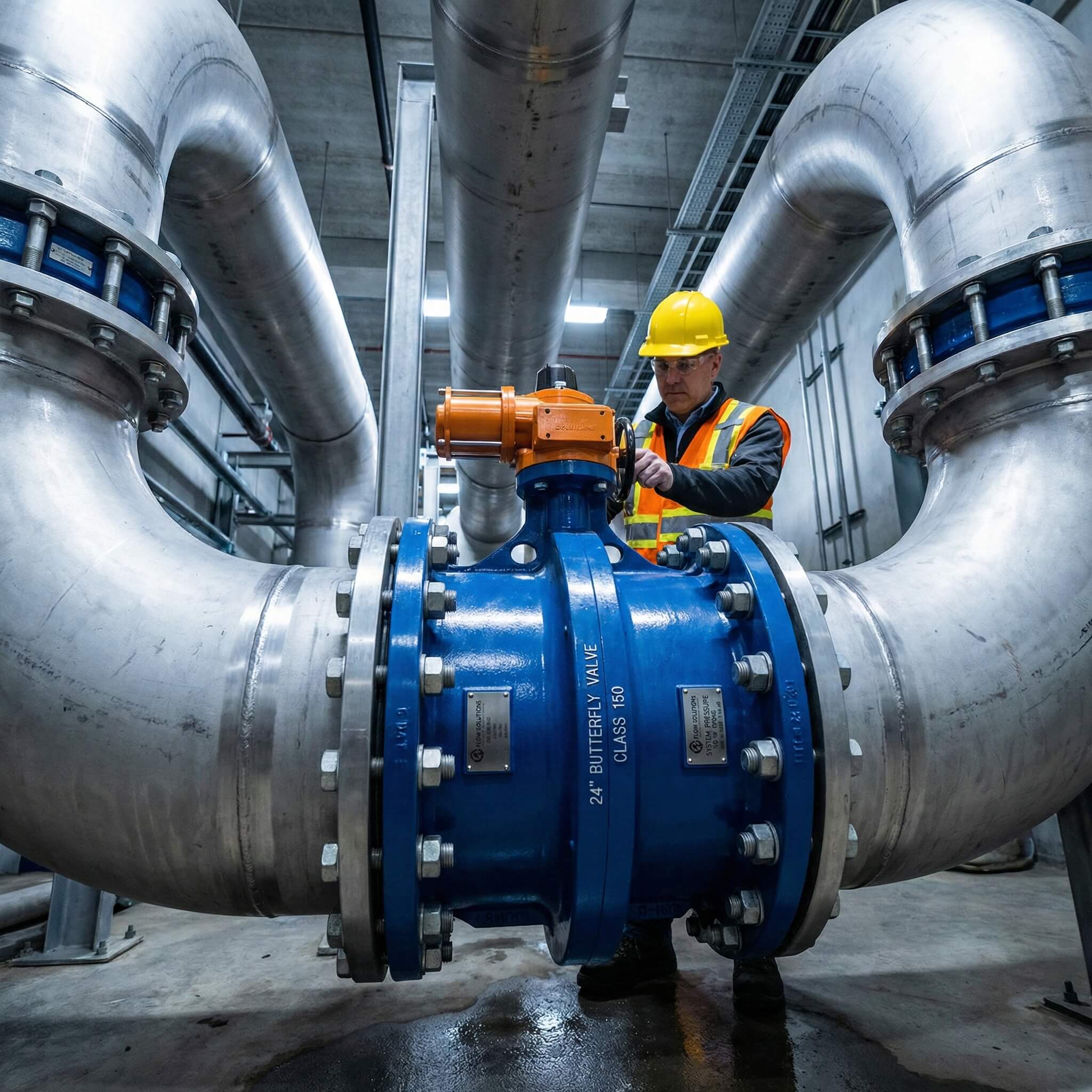
You should use a butterfly valve when you need a compact, cost-effective, and quick-acting solution for flow regulation or isolation in medium to large-diameter pipelines. Engineers and facility managers often struggle to select a valve that balances high flow capacity with space constraints and budget limitations in large-scale piping systems. Choosing an unnecessarily heavy or complex valve like a globe or gate valve for large-diameter pipes leads to inflated installation costs, difficult maintenance, and increased structural stress on the pipeline. Understanding exactly when to use butterfly valve specifications allows you to streamline your operations and reduce long-term infrastructure costs.
Why choose a butterfly valve for large pipes?
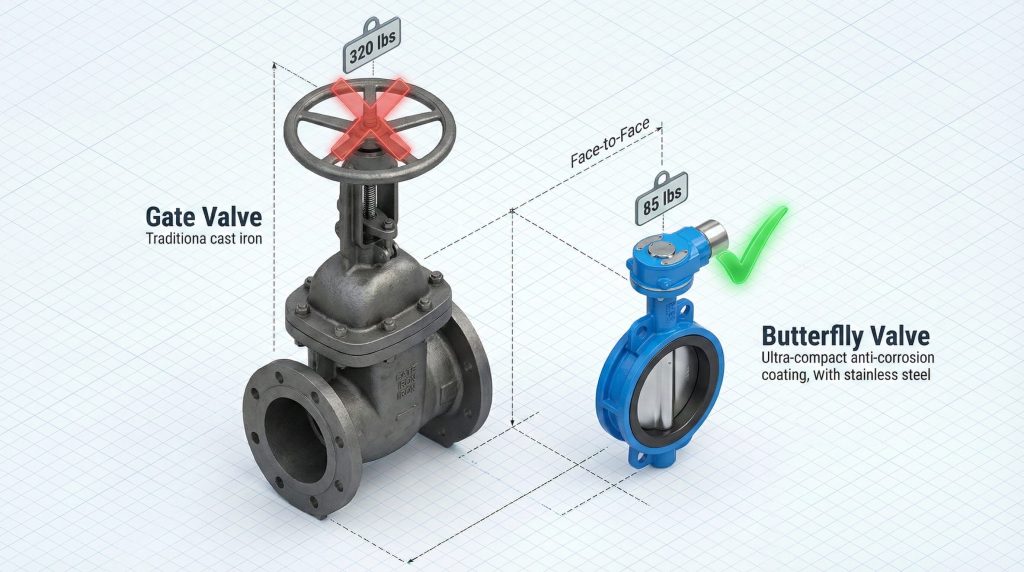
Butterfly valves are chosen for large pipes because they offer a superior strength-to-weight ratio and a significantly smaller installation footprint than alternative designs. This makes them the primary choice when you are working with limited space or need to reduce the mechanical load on the pipe supports. Determining when to use butterfly valve units in these scenarios often comes down to the necessity for a lightweight assembly that simplifies the installation process for your field crew.
Lightweight design for easy installation
The thin, disc-like structure of these valves ensures they weigh up to 70% less than a comparable gate valve. This massive weight reduction translates directly into lower shipping costs and safer handling on the job site.
- Reduced need for heavy lifting equipment during assembly.
- Lower structural requirements for pipe hangers and supports.
- Faster alignment within the piping system due to the compact body.
Minimal footprint in restricted spaces
Here is the deal: space is often at a premium in modern industrial plants. Because the valve body is much narrower than a globe or ball valve, it can fit into tight galleries where other valves simply cannot.
- Short face-to-face dimensions allow for high-density piping.
- The quarter-turn handle or actuator requires less clearance for operation.
Key Takeaway: Butterfly valves provide the best strength-to-weight ratio for large-scale operations and tight installation environments.
| Pipe Diameter | Valve Type | Estimated Weight | Relative Footprint |
|---|---|---|---|
| 12 Inch | Butterfly | 85 lbs | Small |
| 12 Inch | Gate | 320 lbs | Large |
| 24 Inch | Butterfly | 250 lbs | Medium |
| 24 Inch | Gate | 1,100 lbs | Very Large |
The data indicates that butterfly valves offer a drastic reduction in both weight and physical volume as pipe diameter increases.
How does it compare to a ball valve?
Comparing these two reveals that butterfly valves are generally more cost-effective for large diameters, whereas ball valves provide better sealing at high pressures. You must evaluate the specific pressure and budget constraints of your project to decide when to use butterfly valve technology over ball valves. While both are quarter-turn, the central disc of the butterfly valve is always present in the flow stream, which is a critical distinction for your fluid dynamics.
Evaluating cost-effectiveness in large sizes
As your pipe size increases, the price of a ball valve rises exponentially due to the mass of the solid ball. Butterfly valves remain relatively affordable because the disc is a thin plate rather than a heavy sphere.
- Lower material costs for stainless steel or exotic alloy versions.
- Economical replacement parts for seats and seals.
Understanding pressure drop differences
But there’s a catch: because the disc stays in the middle of the pipe, it creates a constant pressure drop. While ball valves provide a clear path (full port), the butterfly valve’s obstruction must be accounted for in your pump head calculations.
- Suitable for systems where a slight pressure drop is acceptable.
- High flow capacity despite the presence of the disc.
Key Takeaway: While ball valves offer better sealing at high pressure, butterfly valves are superior for cost and space in large diameters.
| Feature | Butterfly Valve | Ball Valve |
|---|---|---|
| Sealing Performance | Good (Resilient Seated) | Excellent |
| High Pressure Suitability | Moderate | Very High |
| Weight at 10″+ Sizes | Light | Heavy |
| Cost for 12″ Stainless | Economical | Expensive |
Butterfly valves prioritize economic efficiency and spatial economy, making them the preferred choice for large-diameter, lower-pressure water or air lines.
Is it suitable for wastewater systems?
Butterfly valves are highly suitable for wastewater systems because their streamlined disc design minimizes the areas where debris and solids can accumulate. When considering when to use butterfly valve components in treatment plants, you should focus on areas where high flow and frequent isolation are required. These valves excel in managing raw sewage, sludge, and aeration lines where traditional valves might jam or fail due to buildup.
Managing fluids with suspended solids
The rotating disc effectively “cuts” through the media, ensuring that large particles do not block the closing mechanism. This makes them far more reliable than gate valves, which have a bottom groove where grit often collects.
- Self-cleaning action during the opening and closing cycles.
- Resilient seats can absorb small particles without losing the seal.
- Durable materials like ductile iron withstand abrasive slurries.
Can they handle sludge lines?
Sludge and aeration processes require consistent flow regulation that can be easily automated. But here is the deal: butterfly valves allow for precise enough control to balance aeration tanks without the high cost of specialized control valves.
- Quick response times for automated sludge wasting.
- Low torque requirements for pneumatic or electric actuators.
Key Takeaway: The disc design prevents significant buildup, making it ideal for managing slurry and wastewater at various treatment stages.
| Wastewater Stage | Suitability Rating | Recommended Material |
|---|---|---|
| Primary Influent | High | Ductile Iron / EPDM |
| Aeration Lines | Excellent | Stainless Steel / PTFE |
| Sludge Handling | High | Cast Iron / Buna-N |
| Disinfection | Moderate | PVC / Viton |
The suitability of butterfly valves remains high across most wastewater processes, particularly where the media contains non-fibrous suspended solids.
When to use it for HVAC and building services?
You should use a butterfly valve in HVAC systems for balancing and isolating large chilled water or heating loops due to their rapid operation and compact size. Knowing when to use butterfly valve setups in building services is key to maintaining climate control efficiency and ensuring that maintenance crews can quickly isolate sections of the boiler or chiller plant. Their versatility allows them to serve as both shut-off and moderate throttling devices in these commercial environments.
Regulating flow in cooling towers
Cooling towers require reliable valves to manage the massive volumes of water circulating through the building’s heat exchangers. Butterfly valves are perfect here because they can be automated to respond to temperature sensors.
- Facilitates efficient water distribution across tower basins.
- Resists corrosion from treated cooling water.
- Easy to integrate with building management systems (BMS).
Is it efficient for boiler isolation?
Heating loops often operate at temperatures where standard valves might struggle with expansion. However, high-performance butterfly valves handle these thermal cycles effectively while providing a tight shutoff for summer maintenance.
- Quarter-turn action speeds up emergency isolation.
- Lug-style bodies allow for downstream pipe removal.
Key Takeaway: Their quick quarter-turn operation and high flow capacity are perfect for balancing and isolating complex HVAC loops.
| Application Point | Valve Benefit | Actuation Type |
|---|---|---|
| Chiller Inlet | Space Saving | Electric |
| Cooling Tower Bypass | High Flow | Pneumatic |
| Boiler Header | Thermal Resistance | Manual Gear |
| Room Branch | Compact Size | Manual Lever |
Butterfly valves dominate the HVAC sector because they provide reliable performance in the large-diameter pipes common in central utility plants.
Why is it preferred over gate valves?
Butterfly valves are preferred over gate valves because they provide much faster actuation and occupy significantly less space in the pipeline. When determining when to use butterfly valve hardware instead of traditional gates, you must consider the safety implications of slow-closing valves in an emergency. While gate valves are multi-turn and slow, the butterfly valve requires only a 90-degree rotation to move from fully open to fully closed.
Faster actuation for emergency shutoff
In critical situations where a line must be closed immediately to prevent a spill or equipment damage, speed is everything. Butterfly valves can be closed in seconds, whereas a large gate valve might take several minutes to manually crank down.
- Improved safety protocols for hazardous fluid lines.
- Lower wear on automated actuators due to reduced travel distance.
Lower maintenance requirements over time
But there’s a catch: gate valves often suffer from stem leakage and seat erosion because they are not used frequently. By contrast, choosing butterfly valves for fast flow control ensures that the internal components are simple and less prone to seizing.
- Fewer moving parts translate to a lower probability of mechanical failure.
- Routine seal replacements can be done without removing the entire body.
Key Takeaway: Butterfly valves operate significantly faster than multi-turn gate valves, enhancing both system safety and operational efficiency.
| Metric | Butterfly Valve | Gate Valve |
|---|---|---|
| Actuation Time | 1–10 Seconds | 60–300 Seconds |
| Maintenance Frequency | Low | Moderate |
| Installation Effort | Easy | Difficult |
| Throttling Capability | Moderate | Poor |
The comparison shows that butterfly valves outperform gate valves in nearly every category except for high-pressure, zero-leakage gas applications.
Can you use it in compressed air systems?
Yes, you can use butterfly valves in compressed air systems for rapid isolation and managing high-volume distribution lines where precision throttling is not the primary concern. Identifying when to use butterfly valve options in air systems usually involves looking at the main headers or receiver tank outlets. They provide a cost-effective way to shut down large sections of a factory’s air supply for repairs or during fire suppression events.
Rapid isolation for receiver tank outlets
Large air receivers store significant energy, and in the event of a downstream pipe failure, you need to isolate that tank quickly. Butterfly valves offer the speed necessary to prevent a total loss of system pressure.
- Prevents expensive compressed air leaks in large-diameter mains.
- High-flow design ensures minimal pressure drop during peak demand.
Emergency shutdown in fire suppression
Here is the deal: in fire suppression systems, valves must be reliable and easy to see. Many butterfly valves come with built-in tamper switches and visible indicators that show exactly if the valve is open or closed.
- UL/FM approved versions are available for fire protection.
- Minimal torque is required to operate the valve manually.
Key Takeaway: Use these valves for air systems where rapid isolation and visible status are more critical than high-precision flow control.
| Air System Location | Valve Material | Function |
|---|---|---|
| Main Header | Carbon Steel / Buna-N | Zone Isolation |
| Receiver Outlet | Stainless Steel / PTFE | Emergency Shutoff |
| Branch Line | Aluminum / EPDM | Maintenance Point |
| Fire Main | Ductile Iron (UL/FM) | System Protection |
Butterfly valves are a staple in industrial air distribution because they offer the most efficient way to manage high-volume airflow.
How do chemical industries benefit?
Chemical industries benefit from butterfly valves because they can be lined with highly resistant materials like PTFE to handle aggressive acids and solvents. Deciding when to use butterfly valve units in chemical processing depends on matching the liner material to the specific chemical compatibility chart. This design allows you to use a standard metal body while keeping the process fluid in contact only with the corrosion-resistant internal lining.
Handling acids, solvents, and process water
Because the disc and seat can be coated or made from specialized alloys, these valves are remarkably versatile in corrosive environments. They are often used for cooling water loops and chemical transfer lines where other valves would corrode quickly.
- Resists a wide range of pH levels and industrial solvents.
- Prevents contamination of the process media.
Selecting the right liner and disc material
But there’s a catch: you must ensure the elastomer or polymer you choose can withstand the process temperature. Fluoropolymer liners offer excellent chemical resistance but have lower temperature limits than metal-seated options.
- EPDM is perfect for basic water and mild acids.
- PTFE/TFM handles aggressive chemicals and higher temperatures.
- Viton is the preferred choice for petroleum-based products.
Key Takeaway: With the correct elastomeric or fluoropolymer liners, these valves resist aggressive chemical corrosion at a fraction of the cost of alloy valves.
| Chemical Type | Recommended Liner | Disc Material |
|---|---|---|
| Sulfuric Acid | PTFE | Hastelloy |
| Sodium Hydroxide | EPDM | Stainless Steel |
| Organic Solvents | Viton | 316 SS |
| Deionized Water | Food-Grade EPDM | Nylon Coated |
Matching the internal materials to the chemical profile ensures a long service life and prevents catastrophic valve failures in hazardous environments.
When to select a triple-offset design?
You should select a triple-offset butterfly valve when your application involves high pressures, extreme temperatures, or the need for a “bubble-tight” seal. When analyzing when to use butterfly valve high-performance variants, the triple-offset design stands out because it eliminates the friction between the seat and the disc. This allows for metal-to-metal sealing that can withstand environments previously reserved for heavy-duty gate or globe valves.
Achieving bubble-tight shutoff
Standard concentric valves use an interference fit that can wear out over time. Triple-offset valves use a camming action that wedges the disc into the seat only at the final point of closure, ensuring a leak-proof seal.
- Zero-leakage performance in critical isolation services.
- Lower operating torque compared to double-offset designs.
High-pressure and high-temperature limits
Can these valves handle steam or hot oil? Yes, because the metal-seated triple-offset design can operate at temperatures exceeding 1000°F. This makes them the logical choice for refinery and power plant applications.
- Fire-safe designs are standard for high-performance models.
- Suitable for ASME Class 300 and Class 600 systems.
Key Takeaway: High-performance triple-offset valves allow for use in extreme conditions that standard concentric valves cannot handle.
| Design Type | Offset Count | Sealing Type | Typical Pressure |
|---|---|---|---|
| Concentric | 0 | Soft (Resilient) | < 150 PSI |
| Double Offset | 2 | Soft or Metal | 150 – 300 PSI |
| Triple Offset | 3 | Metal-to-Metal | 300 – 900+ PSI |
The progression of offset designs allows butterfly valves to compete with traditional heavy-duty valves in the most demanding industrial environments.
Is maintenance easier than other valves?
Maintenance is significantly easier with butterfly valves because they have fewer moving parts and a simplified internal structure that allows for rapid seat and seal replacement. Determining when to use butterfly valve maintenance protocols usually involves a simple visual inspection and periodic lubrication of the stem. Unlike complex globe valves, you do not need to disassemble a massive bonnet to access the sealing surfaces.
Simplified seal and seat replacement
In many resilient-seated designs, the seat can be replaced by simply removing the valve from the line and popping in a new elastomer ring. This reduces downtime from hours to just minutes, keeping your production schedule on track.
- No specialized tools are required for most seat replacements.
- The simple disc design is easy to clean and inspect.
Lubrication and cleaning requirements
Here is the deal: most modern butterfly valves are designed to be permanently lubricated or maintenance-free. However, for valves in heavy-duty service, a quick grease injection into the stem housing is all that is needed to ensure smooth quarter-turn operation.
- Reduced labor costs for annual maintenance shutdowns.
- Smaller inventory of spare parts required for facility management.
Key Takeaway: The simple construction of the butterfly valve reduces downtime and labor costs during routine plant inspections.
| Maintenance Task | Butterfly Valve | Globe Valve |
|---|---|---|
| Seat Replacement | 15 Minutes | 2-4 Hours |
| Stem Lubrication | Simple Port | Complex Gland |
| Weight for Removal | Light | Heavy / Rigging needed |
| Part Count | 5-7 Parts | 15-20 Parts |
By simplifying the mechanical design, butterfly valves lower the total cost of ownership over the life of the piping system.
What are the main limitations to consider?
The main limitations of butterfly valves include a risk of cavitation during precision throttling and sealing challenges at extremely high pressures with soft seats. You should carefully weigh these factors when deciding when to use butterfly valve components in high-energy systems. While they are versatile, they are not the “universal” valve for every single process condition, especially those involving high-pressure gases.
Cavitation risks in throttling applications
When a butterfly valve is partially open, the high-velocity flow around the disc can create low-pressure zones that cause vapor bubbles to form and collapse. This cavitation can erode the disc and the downstream piping if the valve is used for constant, fine-tuned regulation.
- Best used for “on-off” service or coarse flow control.
- Avoid using in high-differential pressure water systems.
Sealing challenges at extreme high pressures
But there’s a catch: soft-seated butterfly valves can deform under massive pressure, leading to leaks. For services involving high-pressure steam or flammable gases, you must upgrade to a high-performance or triple-offset model to ensure safety.
- Not ideal for high-pressure gas storage where zero leakage is mandatory.
- Limited performance in high-frequency cycling with abrasive media.
Key Takeaway: Avoid butterfly valves for high-pressure gas services or precision throttling where cavitation or seal deformation is likely.
| “Red Flag” Scenario | Primary Risk | Recommended Alternative |
|---|---|---|
| High-Pressure Steam | Seal Melting | Triple Offset / Globe |
| Precision Dosing | Cavitation | Needle Valve |
| High-Pressure Gas | Leakage | Ball Valve |
| High Abrasives | Seat Erosion | Pinch Valve |
Understanding these limits ensures that you apply butterfly valve technology only where it will thrive, preventing premature system failures.
Conclusion
Choosing the right valve is the difference between a high-performing system and one plagued by constant maintenance and budget overruns. Butterfly valves are the industry standard for large-scale water, HVAC, and process applications where space, weight, and budget are primary concerns. Their lightweight design and rapid operation provide significant advantages over heavier alternatives like gate or globe valves. At RuitoFlow, we stand by the principle that engineering efficiency starts with selecting the most practical component for the job. If you need expert guidance on selecting the right valve configuration for your industrial project, contact us today for a technical consultation.
FAQ
Can I use a butterfly valve for throttling?
Yes, but with limitations. While they can regulate flow at opening angles between 30 and 70 degrees, they are not ideal for precision control or high-pressure drops where cavitation may occur.
How do I know if I need a wafer or lug style?
Yes, you need to check your piping requirements. Choose the wafer style for a lower-cost, space-saving installation between two flanges, or select a lug style if you need to perform maintenance on one side of the line while the other remains pressurized.
Can I automate a butterfly valve easily?
Yes, because their quarter-turn operation and low torque requirements make them perfectly compatible with standard pneumatic, electric, or hydraulic actuators.
How do I choose the best seat material?
Yes, you must match it to your media. Use EPDM for general water and air, Buna-N for oils, and PTFE for aggressive chemicals or higher temperatures.
What is the maximum temperature for these valves?
No, there is no single limit, as it depends on the design. Soft-seated valves are usually limited to 400°F, while metal-seated triple-offset valves can handle temperatures over 1000°F.